Tag your entire catalog in one batch.
Upload hundreds of tracks and get thorough, consistent metadata analysis for every one: BPM, key, genres, moods, emotions, instruments and 35+ fields.
No credit card needed to test·library indexing happens 100% locally
Drag in a folder. Walk away with a tagged catalog.
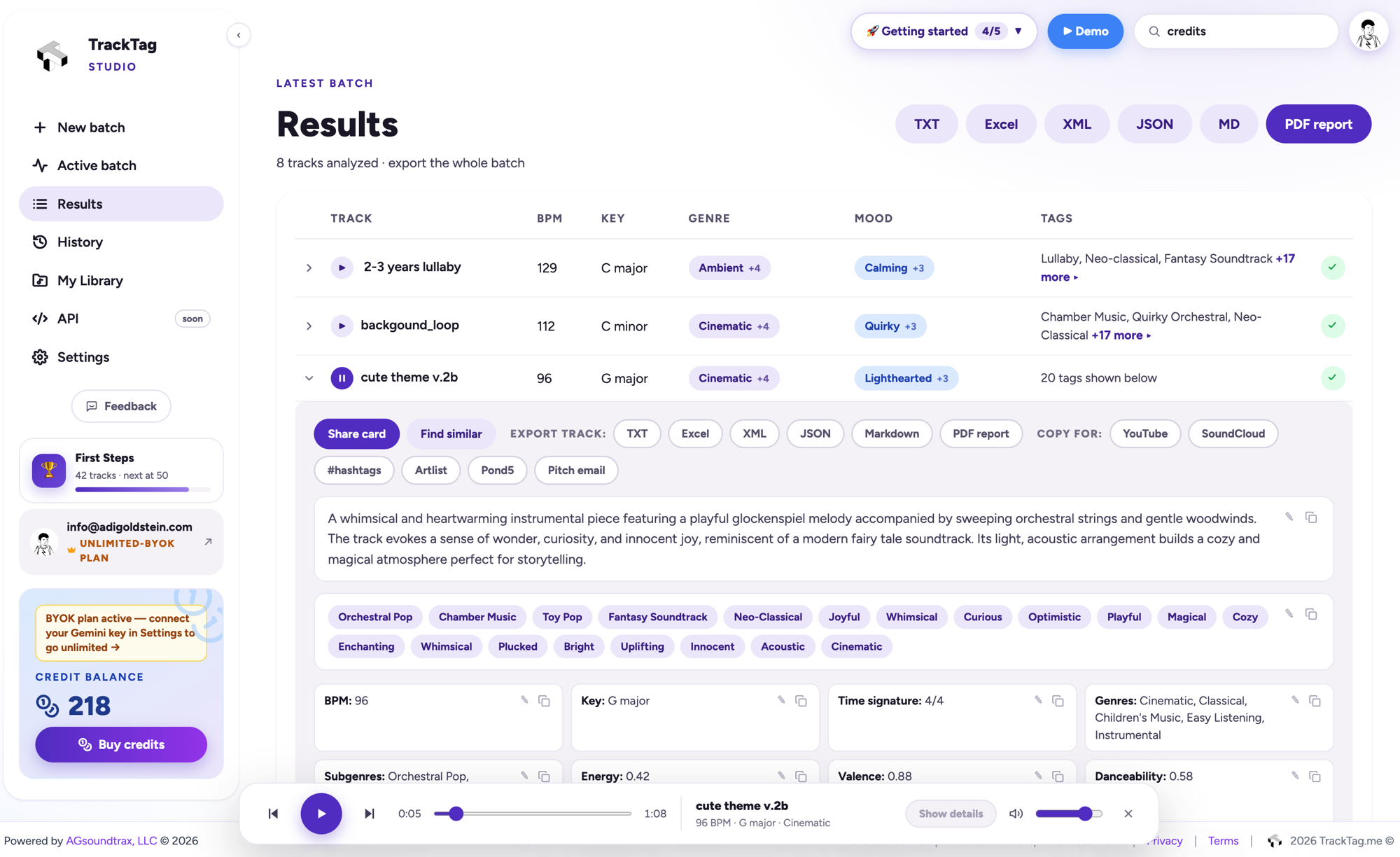
Drop your tracks, Studio analyzes the whole batch, and every file comes back with 35+ fields, ready to copy or export.
Built for catalogs, not one track at a time.
Batch audio analysis
Drop in hundreds of files and analyze the whole set in one pass.
In-depth track insights
Every track gets a full read: energy, structure and tonal detail.
35+ metadata fields
BPM, key, genre, mood, emotion, instrumentation and much more.
Custom field taxonomy
Rename any field to match an agency template before you export.
My Library file manager
Index your local folders right in the browser. Nothing uploads.
Built-in audio converter
Convert between formats without ever leaving the studio.
Searchable catalog
Find anything by mood, BPM, key or any field you choose to track.
Overview stats & reports
See your catalog at a glance, then export CSV and PDF reports.
Zapier, API & MCP
Results flow into Google Sheets, Notion, your code or your AI assistant.
Measured BPM & key
Precision Mode reads tempo and key from the audio itself instead of guessing.
Mac & Windows app
Run Studio natively, and your music folders stay connected between sessions.
Bring your own key
Point Studio at your own Gemini key and run the batch engine credit-free.
From folder to finished metadata in three steps.
Connect or upload
Point Studio at a local folder or drag in a batch of files.
Analyze in batch
Studio reads every track and fills 35+ fields consistently.
Export in your taxonomy
Map fields to your template and export as CSV or PDF.
Prefer a real desktop app? Same Studio, permanent library, native folder access.
Pay for what you tag. Nothing you don't.
One-time credit packs: 1 credit tags 1 track. No subscription, and credits never expire. New accounts get 20 free credits to try Studio.
Now on
Send your track data anywhere
TrackTag connects to 6,000+ apps through Zapier. These are the ones musicians wire up first.

Catalog spreadsheets that fill themselves with BPM, key and tags

Drop a track in a folder, get it analyzed automatically

New uploads flow straight into analysis, no copy-paste

Release databases that update themselves with every analysis

A music library where every row carries full track metadata

A designed analysis report lands in your inbox per track

Your label's channel pings when a new analysis is ready

Share fresh track data with your producer community

Instant track reports in your artist group chat

Release boards where cards carry the track's real data

Fan newsletters triggered by your newest releases

Beat stores that list BPM and key on every product
Catalog spreadsheets that fill themselves with BPM, key and tags
Drop a track in a folder, get it analyzed automatically
New uploads flow straight into analysis, no copy-paste
Release databases that update themselves with every analysis
A music library where every row carries full track metadata
A designed analysis report lands in your inbox per track
Your label's channel pings when a new analysis is ready
Share fresh track data with your producer community
Instant track reports in your artist group chat
Release boards where cards carry the track's real data
Fan newsletters triggered by your newest releases
Beat stores that list BPM and key on every product
Works with any Zapier plan. Uses your TrackTag API key.
The same AI metadata, 60-78% cheaper per track.
TrackTag Studio auto-tags catalogs like the enterprise tools (BPM, key, genre, mood and keywords) with transparent, self-serve pricing instead of sales calls and subscriptions.
 TrackTag Studio
Radically cheaper
5,000 tracks is $499, not $2,250. That's 60-78% cheaper per track.
No sales funnel
See every price, buy, and start in minutes. No demo, no quote.
Built for catalogs
Batch folders, presets and pro exports for libraries and labels.
AIMS and Cyanite also offer similarity-search and recommendation APIs for streaming platforms and large B2B integrations. If you need search-by-reference-track embedded in your product, they cover that. If you need your catalog tagged with quality metadata at a sane price, once or in batches, that's TrackTag Studio.
Competitor pricing based on AIMS' publicly accessible credit pricing and Cyanite's publicly listed subscription tiers as of July 2026, converted per track where applicable. Prices and plans may change; verify current pricing with each vendor. AIMS and Cyanite are trademarks of their respective owners; TrackTag is not affiliated with AIMS or Cyanite.
Your code can use TrackTag. So can your AI, and your spreadsheet.
The TrackTag API tags entire catalogs programmatically: async jobs, signed webhooks, results in seconds. And with the TrackTag MCP server, AI assistants like Claude and Cursor analyze tracks natively: drop in an MP3, say "analyze this", done. As far as we know, we're the first music-tagging platform your AI can use out of the box. No code at all? Zapier connects TrackTag to 6,000+ apps. Analyze a batch in Studio and every result files itself into Google Sheets, Notion or Slack while you work.
- → 35+ fields per track: BPM, key, genres, moods, instruments, description
- → Same credits as Studio, from $0.10 per track · failed jobs auto-refunded
- → Free test keys · open-source MCP server on npm
- → Zapier app: Sheets, Dropbox, Airtable, Slack, no code required
What is TrackTag Studio?
TrackTag Studio is a batch music tagging platform for composers, producers and music libraries. Instead of tagging tracks one at a time, you analyze a whole catalog at once and get the same set of fields (BPM, key, genres, moods, emotions and instruments) filled in consistently across every file, ready to search, filter and export.
Who it's for
It's built for the people who live in large catalogs: composers organizing years of work, production-music and stock libraries preparing tracks for delivery, and music supervisors who need to find the right cue fast. If your work depends on other people finding your music by mood, tempo or key, Studio gets your metadata into shape.
Why consistent metadata matters
For sync and stock placement, consistent, searchable metadata is what makes a catalog usable. When every track carries the same fields in the same shape, a supervisor's search returns the right results and your music actually surfaces. TrackTag Studio applies one taxonomy across the whole library, so a 500-track catalog reads as cleanly as a single track, and your own custom field names carry straight through to export.
Batch AI music tagging for entire catalogs
TrackTag Studio is a batch music tagging tool that auto-tags hundreds of tracks in one run. Drop in a folder of audio files and the AI detects BPM, musical key, genre, mood, instruments, energy and searchable keywords for every track, then exports a clean, marketplace-ready metadata sheet. It's built for sync licensing libraries, production music companies, composers and labels who need consistent metadata across thousands of files without weeks of manual work.
Backfill an old catalog
Tag 500-5,000 legacy tracks in an afternoon. 5,000 tracks cost $499, about $0.10 per track.
Prepare for music libraries
Marketplace presets and pro exports (XLSX, PDF, XML, TXT) formatted for stores and sync platforms.
35+ fields per track
BPM, key, genre, sub-genre, moods, instruments, vocals, energy, tempo feel, keywords and more.
How TrackTag Studio compares to AIMS and Cyanite
TrackTag Studio delivers the same core capability, AI auto-tagging for music catalogs, at a fraction of the price, with transparent self-serve pricing instead of "book a demo" sales calls. Tagging 1,000 tracks costs $149 on TrackTag vs. roughly $550 on AIMS (based on published pricing, July 2026).
TrackTag vs AIMS →·TrackTag vs Cyanite →·Tagging guides →·Blog →
Frequently asked questions
Why do I need TrackTag? Can't I just ask ChatGPT or Claude to analyze my track?
Most chat assistants can't actually hear audio: drop an MP3 into Claude or ChatGPT and they see the file name and metadata, not the sound, so the "analysis" is a guess from the title. And even audio-capable models are not an analysis product: a casual prompt returns different fields, wording and judgments every run. TrackTag processes the actual waveform through a purpose-built pipeline (signal-level analysis of tempo, tonality, timbre, instrumentation and dynamics) and validates every result against a strict 35+ field taxonomy with controlled vocabulary, so track #1 and track #10,000 come back with the same schema and the same standards. That consistency is what makes a catalog searchable, filterable and store-ready.
How does batch AI music tagging work in TrackTag Studio?
Upload up to 100 audio files per run. Studio's AI analyzes each track and returns 35+ metadata fields (BPM, musical key, genre, sub-genre, moods, instruments, energy, vocals and searchable keyword tags) then exports everything as XLSX, PDF, XML or TXT for music libraries and marketplaces.
How much does it cost to tag a full music catalog?
Credit packs start at $20 for 50 tracks. Tagging 1,000 tracks costs $149 and 5,000 tracks costs $499, typically 54-78% cheaper per track than competing AI tagging services like AIMS. Labels can also use Studio Unlimited-BYOK at $49/month with their own Gemini API key for unlimited tagging.
Is TrackTag Studio good for sync licensing and production music libraries?
Yes, Studio was built for exactly that. Marketplace tag presets, a field picker for exports, and batch folders mean you can prepare a sync-ready catalog with consistent metadata in one afternoon instead of weeks of manual tagging.
What audio formats are supported?
MP3, WAV, AIFF, FLAC and other standard audio formats are supported for analysis.